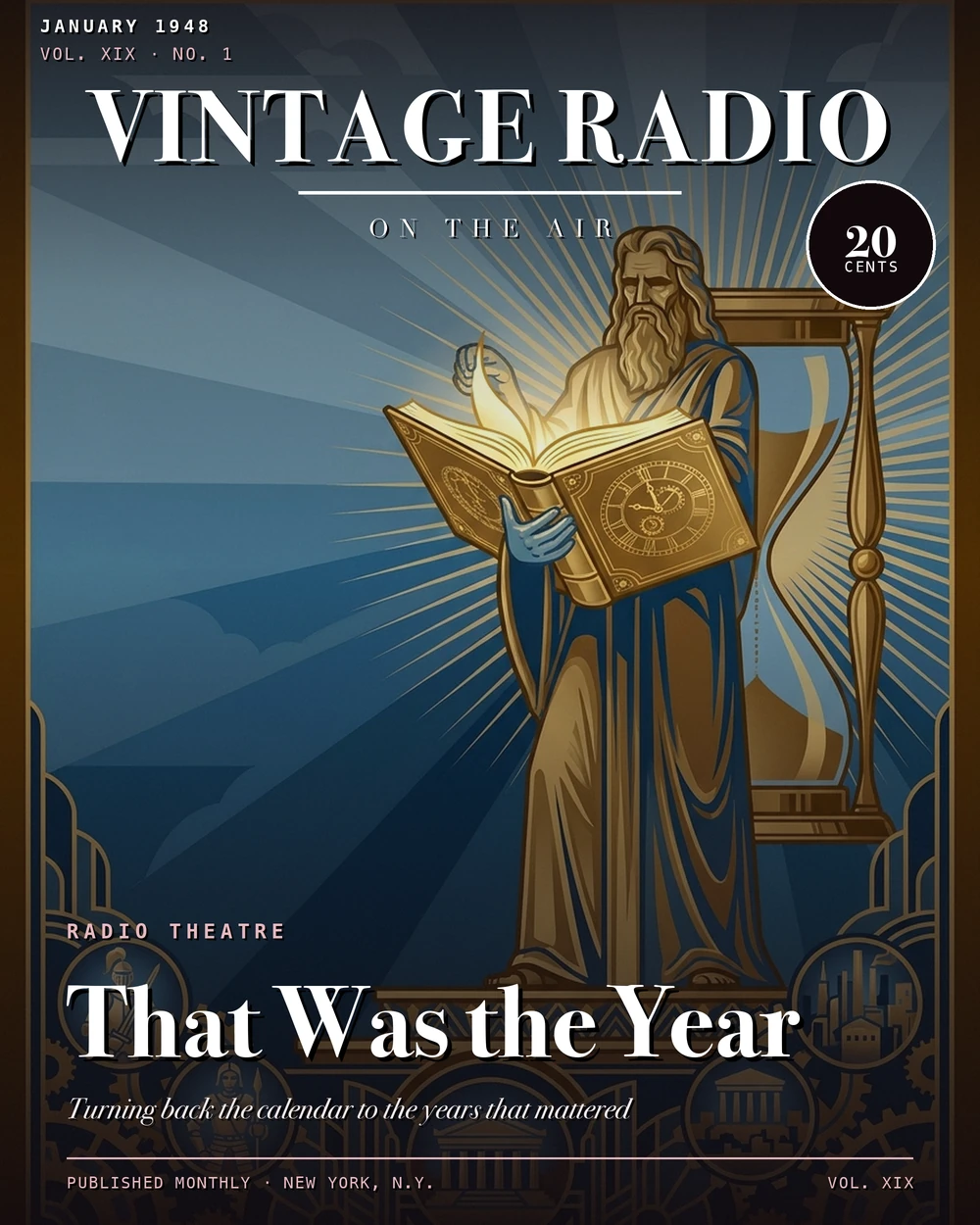
That Was the Year
What the Show Was
That Was the Year did something simple and, in 1937, genuinely unusual for radio: it picked a single calendar year from recent history, gathered up its major events, its music, its public mood, and its political upheavals, and spent fifteen minutes showing listeners how that year helped make the world they were living in. Not a drama exactly, not a documentary in the modern sense — the series is best described as a blend of storytelling and historical analysis, using music, speeches, and the expressed sentiments of the time to pull each featured year back into focus.
Each of the 39 episodes in the catalog covers a year somewhere in the range of 1896 to 1934. The episode titles follow the same plain, confident format throughout: "The Year 1914," "The Year 1927," "The Year 1896." No embellishment needed. The range alone tells you something about the ambition of the project — from the late Victorian era through the Depression years, touching political milestones, cultural breakthroughs, and developments in science and technology. Each episode was described at the time as meticulously researched, and the production treated its subject seriously, contextualizing events within their historical moment while drawing explicit lines toward the world its 1937 audience recognized.
Unusually, the episodes were not broadcast in chronological order. A week that featured the year 1922 might be followed by one covering 1910. The effect would have been something like browsing — listeners tuning in to find out which slice of recent history this week's installment had landed on.
How It Reached Listeners
That Was the Year was not a network show. It was a syndicated transcription package, meaning the episodes were pressed onto transcription discs and distributed to local radio stations across the United States and Canada. Local sponsors would purchase the package and insert their own commercials — which is why the 39 surviving recordings carry no commercial content at all. In their place, each recording has ninety seconds of musical fill at the opening and close, the structural seams where local advertising would have been dropped in. The transcriptions are taken directly from those original discs.
That distribution model made the show an attractive vehicle for local advertisers. A hardware store in Omaha or a department store in Toronto could put its name on a polished, nationally produced history program without the cost of network airtime. The sponsor got credibility; the station got content; and the show traveled much further than it otherwise might have.
The series was first recorded in 1935, then aired beginning in February 1937, with the last known broadcast date falling on October 18, 1937. After that initial run, it was re-syndicated nearly every year for another five to seven years. A later redistribution through Broadcasters Program Syndicate and Bruce Ells & Associates produced a complete 1939 version that remains among the known circulating sets — a sign that the package kept finding buyers well after its original production year.
Gerald Mohr as Host
The voice that carried each episode was Gerald Mohr's — a New York-born actor, born June 11, 1914, who would go on to a prolific radio career on network programs. In 1937, he was still building that career through syndicated work, including Ann of the Airlanes and Front Page Drama in addition to That Was the Year. His baritone was well-suited to the series. History narration lives or dies on the credibility of the voice delivering it, and Mohr's gave the show weight without tipping into pomposity.
Mohr's later career would take him to starring roles on major network programs, but That Was the Year represents his work in the syndication trenches — the part of the radio industry that operated below the level of CBS and NBC but kept local stations stocked with produced content. He died November 9, 1968.
What Made It Work
The structure of each episode was consistent enough to become its own kind of ritual. The program moved through the political, cultural, and scientific events of the featured year, examined how they shaped subsequent decades, and then closed with a performance of a popular song from that same year. That musical sign-off was more than a production flourish — it grounded the episode in the lived texture of the year being discussed, a reminder that history isn't only events but also what people were humming while those events unfolded.
The show was produced from the perspective of 1937, which gives modern listeners an additional layer of distance and interest. The creators and their audience were themselves only a few years removed from some of the episodes' subjects. When the series covered 1927 or 1919, those weren't ancient history — they were lived memory for a substantial portion of the listening audience. That proximity shaped how the show framed its material, treating relatively recent events with the kind of analytical seriousness that earlier generations might have reserved for ancient Rome.
The fifteen-minute format was tight but workable for the scope. A full hour of historical survey per year would have been unwieldy for a syndicated package; a quarter-hour forced the writers to make choices about what actually mattered and why. The constraint almost certainly improved the writing.
What Survives
The series exists largely outside the formal canon of old-time radio, without a standard reference-work entry to its name, and that absence has kept it from receiving the attention it might otherwise have earned. What's available are the 39 recordings taken from the original transcription discs — clean transfers that reflect what local stations would have aired, minus the commercial spots that varied by market.
The sample episode titles suggest a particular interest in the years surrounding the First World War and its aftermath: 1914, 1915, 1918, 1919, and 1921 are all represented, alongside cultural turning points like 1896, 1902, 1904, 1907, 1924, 1925, and 1927. The full spread of the 39 episodes covers the entire 1896–1934 range, which means the series didn't shy away from the difficult years — the war, the pandemic, the economic collapses — or the quieter ones where cultural and technological shifts were doing slower, equally consequential work.
For anyone interested in how 1937 Americans understood their own recent past — which turning points they chose to revisit, which events they saw as consequential, which years they judged worth a quarter-hour of radio — the series functions as something close to a primary source. The production itself is the artifact.